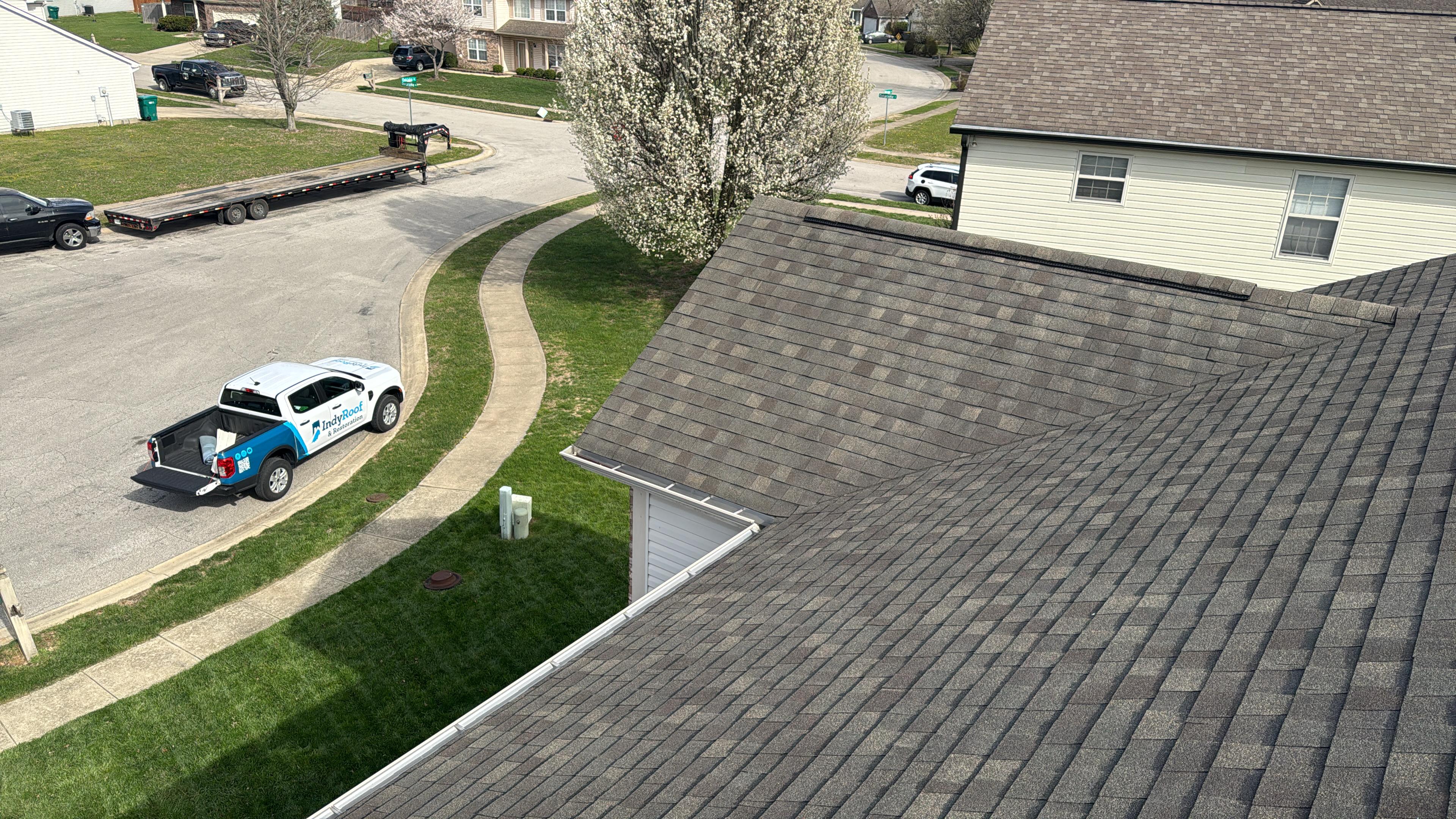
Start with the gutters, because everything else downstream depends on them. A clogged gutter is not just a cosmetic issue. When water cannot move, it backs up under the drip edge, soaks the fascia, and in a Chalmers December it freezes into the kind of ice dam that pries shingles loose and drips through your ceiling at two in the morning. We see this every January without fail, and the homeowners are always surprised, even though the warning signs were visible in October. If you can safely get on a ladder, scoop the debris out by hand, flush the runs with a garden hose, and watch where the water actually goes. If it pools near the foundation or overshoots the gutter entirely, you have a slope problem or a downspout problem, and both are cheap fixes in October and miserable ones in February.
While you are up there, look at the gutter itself. Separations at the seams, rusted spots the size of a quarter, and spikes pulling away from the fascia are all signs that the system is tired. Continuous aluminum gutters on a typical Chalmers two story run a few hundred to a couple thousand dollars depending on linear footage, and replacing them in the fall is cheaper and easier than waiting until spring when every contractor in Chalmers is backlogged from storm season. If your current gutters are holding up fine, add guards or screens only if the tree cover genuinely warrants them. They are not magic, and cheap ones actually make cleaning harder. Pay attention to the downspouts too, because a gutter that drains perfectly into a crushed or disconnected downspout is just routing water to a different problem. Extensions should carry runoff at least four to six feet away from the foundation, and splash blocks that have shifted over the summer need to be reset before the ground freezes. A surprising number of wet basement calls in Chalmers trace back to nothing more complicated than a downspout dumping directly against a block wall for years.
What to Look For on the Roof Itself
Once the gutters drain the way they should, turn your attention to the field of the roof. You do not need to walk it. A pair of binoculars from the yard will tell you almost everything. Look for shingles that are curling at the corners, shingles with bald spots where the granules have worn off, and any area where the surface looks darker or shinier than the rest. Granule loss is normal for the first year on a new roof and again in the last few years of its life, so a little grit in the gutter from a ten year old roof is not a crisis. A handful of loose tabs after a windy week in September, though, is worth a closer look. Our guide to signs your roof needs replacement walks through the visual cues in more detail if you want a second opinion before calling anyone.
Flashing is where most fall inspections actually earn their keep. The metal around your chimney, the boots around plumbing vents, and the step flashing where the roof meets a wall are the places water wants to get in. Rubber vent boots crack after about ten to fifteen years in Chalmers sun, and when they split you get a slow leak that shows up as a brown ring on a bedroom ceiling months later. Caulk at the chimney counterflashing dries out on a similar timeline. These are small repairs, often under a few hundred dollars, and they are exactly the kind of thing a fall visit catches. If you already know something is wrong up there, our roof repair team can handle targeted fixes without pushing a full replacement you do not need. Pay attention to the valleys as well, since those long metal or woven channels carry more water than any other part of the roof and wear out first. Debris that settles in a valley over the summer holds moisture against the shingles, and by the time you notice the staining it has usually been working on the decking underneath for a season or two.
Attic, Trees, and the Things People Forget
Half of fall roof maintenance happens from inside the house. Go into the attic on a bright afternoon, turn off your flashlight, and look for daylight. Any pinhole of sun coming through the decking is a pinhole of water later. Check the insulation for dark streaks, which indicate air movement through gaps, and press on the underside of the decking near any vent or valley to feel for softness. A soft spot means moisture has already been working, and that conversation needs to happen with a roofer before snow loads up. While you are there, confirm that bathroom and kitchen vents actually exit through the roof or a sidewall, not into the attic itself. That single mistake is responsible for a huge share of the mystery mold calls we field every winter. Ventilation matters more than most people realize, because a properly balanced attic (with intake at the soffits and exhaust at the ridge) keeps the underside of the decking cold enough to prevent the melt and refreeze cycle that creates ice dams in the first place. If your soffit vents are painted shut or packed with blown in insulation, you are fighting winter with one hand tied behind your back.
Outside, walk the perimeter and look up at the trees. Any limb that can reach the roof in a storm will reach the roof in a storm, and a wet October wind in Chalmers is more than enough to bring a dead branch down on your shingles. Prune back anything within about six feet of the roofline, and pay special attention to limbs hanging over the gutters, because those are the ones dropping the leaves that clog the system in the first place. If a tree is too big for a pole saw, hire an arborist in October rather than a roofer in January. Moss and algae on the north facing slopes deserve a glance too. A light dusting is cosmetic, but a thick green mat holds moisture against the shingles and shortens their life by years. Zinc or copper strips installed along the ridge will handle this quietly over time, and they are far cheaper than the pressure washing a neglected roof eventually requires.
Homeowners often ask whether they should just schedule a professional look instead of doing any of this themselves, and the honest answer depends on your comfort on a ladder and the age of your roof. Anything past the fifteen year mark on a three tab asphalt roof deserves a set of trained eyes annually, and our free inspections exist for exactly that reason. We are not going to invent a problem, and if the roof has three good years left, you will hear that in plain English. The goal at Chalmers Roofing has always been to keep you ahead of the weather, not chasing it, and a quiet October afternoon spent on these details is usually the difference between a boring winter and an expensive one.
The one thing most homeowners skip is the attic, and it is the one that matters most heading into winter. The roof surface gets a look from the driveway, the gutters get cleared, but almost nobody climbs into the attic to check insulation depth, look for daylight around penetrations, or feel whether the air is moving. That attic is where ice dams are won or lost, since it controls the deck temperature all winter. A few minutes up there in the fall, or a Chalmers inspection that includes it, is worth more than any amount of attention paid to the shingles alone.